// Koshland Park & Garden

Brief History of Koshland Community Park

In the predawn hours of a morning in March 1973, a terrible arson fire swept through a fifty-unit, four-story apartment building at 343 Page Street. This was at the time that blocks and blocks of the Fillmore District were burned down by arson fires.

The apartment building was destroyed, four people died, and scores of tenants had to find new homes. As the burned out shell stood waiting for demolition, many neighborhood residents had the idea of combining the building’s lot with the adjacent vacant lot on the corner to make a park.

The Trust for Public Land (TPL) offered its help. TPL knew that one of San Francisco’s outstanding philanthropic families, the Koshland family, was interested in creating a new park for San Francisco to honor their father. They decided to locate the park in our neighborhood after TPL obtained options on the land parcels.

Mayor George Moscone, the Koshland Family, and community residents dedicated the Daniel E. Koshland Community Park on October 11, 1973. The architectural firm of Royston, Hanamoto, Beck & Abey was hired to build the award-winning park.

Neighbors participated in the design and building of the park. The first planning meeting held at UC Extension, brought well over two hundred residents. After polling over 3,500 people in the neighborhood, four hundred returned questionnaires were received, with ideas of how to design the park. Main issues were facilities for children, open green space, wood as a building material, closing the half-block of Buchanan Street, limiting dogs, and having neighborhood people work on the construction. It was clear that the process of participation was as important as the result.

Thanks to a rare combination of private philanthropy, public-spirited urban conservation, neighborhood participation, and pressing need, this park became the largest new park in San Francisco in forty years. With the completion of Koshland Park in 1976, it represented a rare opportunity, in the midst of racial, economic and political differences, to reverse some of the futility and decline characteristic of much of city life at that time.

Unfortunately, after the demise of The Neighborhood Foundation in 1983, the further deterioration of Hayes Valley South Development, and the 1989 earthquake, prostitution and drug activity became embedded in the park. Residents no longer felt safe there, or in their neighborhood.

It was at this time in Hayes Valley, and within a four-block radius of Koshland Park, that the City experienced the highest crime rate and the largest concentration of low-income, at-risk families. Drug dealers sat on the steps of Koshland Park directing drop-offs with their walkie-talkies. Prostitutes used a secluded play structure and ultimately burned it down. At least one dead body was found in the Park. Neighbors lived in fear, and mistrusted the police. Finally, Recreation and Park Gardeners were threatened at gunpoint and refused to clean the park.

In response to a mandate from the State of California to study substance abuse, Neighborhoods in Transition—A Multicultural Partnership (NIT-AMP) began a five-year study in 1990 of nine transitional neighborhoods in San Francisco—one of them Hayes Valley. NIT-AMP brought together over one hundred residents in 1994 to address neighborhood problems head on. Four committees were formed: Youth, Prostitution, Drugs, and Parks. All the committees worked together and began networking with City agencies and the Police. The parks group, later named the Hayes Valley Neighborhood Parks Group (HVNPG), and in 2008 renamed CommunityGrows, brought schools,
churches, community based organizations, merchants and residents on board to hold work-days, plan celebrations, and raise over two million dollars for the renovation of Koshland Park and two other parks in the neighborhood.

It was a wake-up call for the HVNPG (CommunityGrows), finding their way in the fundraising world, working with politicians, learning the fallibleness of City Departments, and winning the trust of neighbors while working with the police. Town Hall meetings were held, designs were debated and agreed upon, the Koshland Family again graciously offered financial support, the housing development was demolished and rebuilt, and the park began its journey towards renovation.

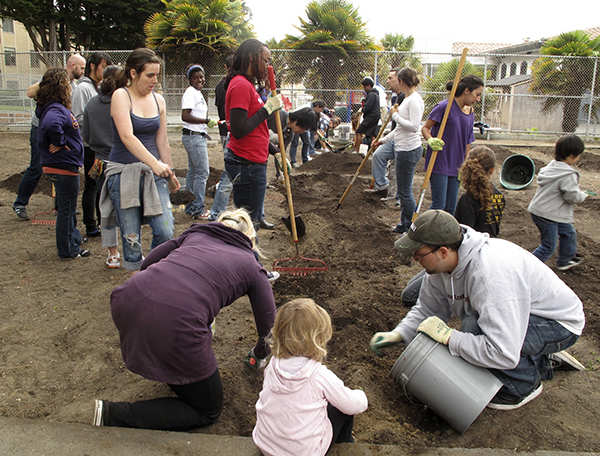
As part of the design plan, and to build stewardship for the Park, HVNPG (CommunityGrows) created two projects, the Community Learning Garden, in the lower east end of the park, and the Western Addition Peace Wall along Page and Buchanan Streets of the Park.

In addition to these two projects, the park was upgraded to make it wheelchair accessible. There is a multi-use area for basketball, neighborhood events and informal recreation. In the center top area of the park there is a play structure for school age and pre-school play. This area is visible from the street and gives a beautiful image to the park. Surrounding the play structure are benches and picnic tables. Finally, a beautifully ornamental wrought iron fence secures the park.

CommunityGrows is committed to building stewardship for the Park and working with the City to sustain it into the future. Koshland Park is a park of tremendous value and rich in history. The Park and Learning Garden are truly diamonds in the rough, hidden treasures in an urban landscape. These are precious resources that make our beautiful City of San Francisco the showcase that it is. Welcome, enjoy and care for the park so it can maintain its resilience, vitality, and importance as a focal point for the community.

Visit the Garden!

Come visit the Koshland Park & Garden anytime to volunteer or for special community events. Bring along a friend or your family with you if you come. The more the merrier!

Map of Koshland Garden(PDF)

Located between Page St. and Buchanan St.


View Larger Map

Stay in Touch

Support CommunityGrows

donate